Nonprofit Website Guide: Donations, Volunteers and Key Rules
 By Matthew Firth, founder of ModelBrain · Nov 22, 2026 · 8 min read
The short answer: a nonprofit website should make three things easy: understanding what you do, giving, and getting involved. Lead with your mission and real results, put a Donate button on every page, and make volunteering a simple form. Before you ask for money online, check whether your state requires charity registration, and know the IRS rules for donation receipts. This page covers the pages donors expect, the IRS and state rules, and sample receipt wording you can adapt.
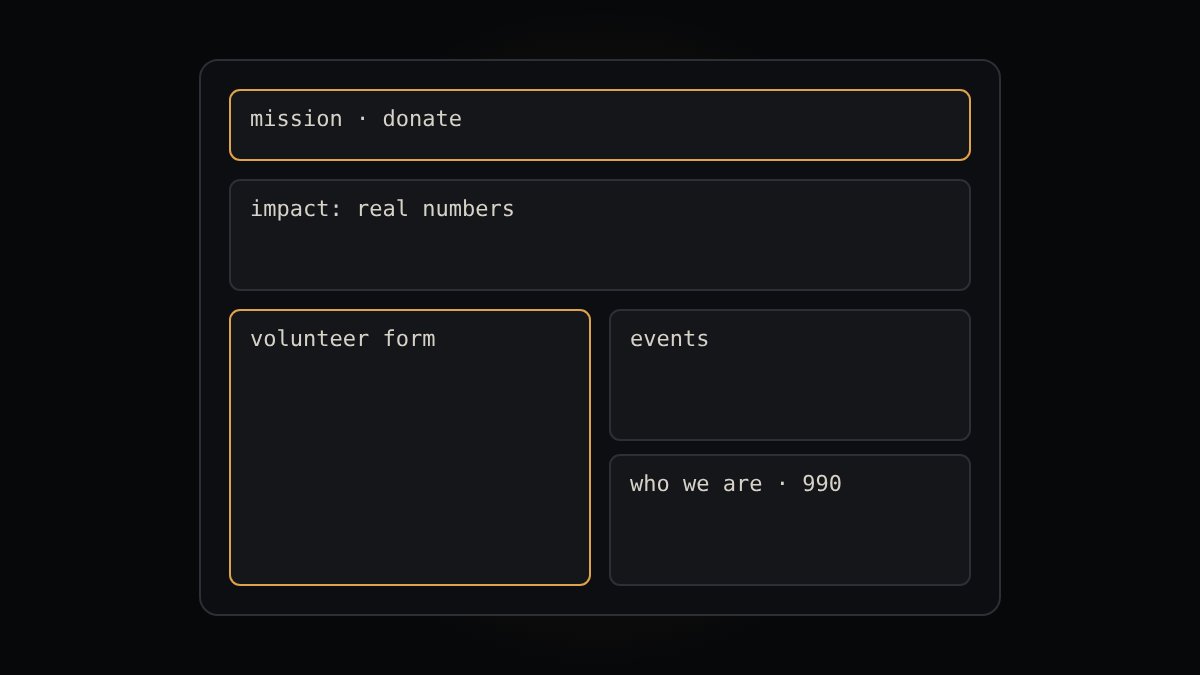
The pages donors look for
- Your mission in one sentence, at the top, in plain words: who you help and how.
- Results: a few honest numbers and one short story. "312 families fed last winter" beats "making a difference".
- Donate, as a button in the header and at the end of every page.
- Get involved: a volunteer signup, upcoming events, and other ways to help, such as donating goods.
- Who you are: board and staff, your legal name, tax status and EIN, and a link to your latest annual report or Form 990.
- Contact and a newsletter signup, so interested people can stay in touch.
Donations
Most small nonprofits use a donation platform or payment processor rather than building their own. Choose one that sends receipts automatically, and link to it from a clear Donate button. On the page, say what a gift does, using real costs; offer monthly giving if you can handle it; and say where to send a check, for donors who prefer that.
The IRS receipt rules
These apply if you're a 501(c)(3) or otherwise eligible to receive tax-deductible gifts.
- Gifts of $250 or more: a donor can't claim a deduction for a single gift of $250 or more without a written acknowledgment from you. Many platforms send these automatically; check that yours does.
- Gifts where the donor gets something back: if someone pays more than $75 and receives goods or services, such as a gala ticket, you must give them a written statement of how much of the payment is deductible. The IRS penalty for missing it is $10 per contribution, up to $5,000 per event or mailing.
A simple acknowledgment for a cash gift with nothing given in return can read:
Thank you for your gift of $300 to Riverside Food Share, received on March 3, 2027. No goods or services were provided in exchange for this contribution. Riverside Food Share is a 501(c)(3) organization, EIN 00-0000000.
The key line for the IRS is the statement about whether anything was given in return. IRS Publication 1771 has the full rules and more sample wording; the organization above is made up.
State charity registration
Charity registration is a state matter, separate from your federal tax-exempt status. About 40 states and Washington, D.C. require charities to register before soliciting donations, and a Donate button can count as soliciting. State charity officials' guidelines on internet fundraising, known as the Charleston Principles, are advisory, and states apply them differently. Connecticut, for example, says an organization based there that only solicits through a donate button on its website must register in Connecticut, while an out-of-state group with only a passive donate button doesn't need to.
A practical approach for a small organization: start with your home state: register there if it requires it, then in any state where you actively ask people for money, such as through targeted emails or events. Your state attorney general's or secretary of state's charity office can tell you what applies. This is general information, not legal advice.
Volunteers and events
A volunteer form should ask for name, email, phone, what they'd like to help with, and when they're available. Keep it short and reply quickly; volunteers who hear nothing don't come back. For events, list the date, time, place and how to sign up, and take past events down once they're over.
Privacy and accessibility
- Don't publish donor names without permission, and get consent before posting photos of the people you serve, especially children.
- Explain in a short privacy notice what you do with donor and volunteer details.
- Make the site readable for everyone: good contrast, real text instead of text in images, descriptions on photos, and forms that work with a keyboard.
Drafting it with an AI assistant
If you'd rather not build it by hand, tell an AI assistant about your organization and let it draft the pages; a publishing service that connects to the assistant can then put it online. Give it your mission, programs, real figures, upcoming events, and your donation link. Ask for a Donate button in the header, a volunteer form and a "Who we are" section with your tax status. Check every number before you publish; an assistant will invent impressive-sounding impact figures if you don't give it real ones. There's a step-by-step example, and a comparison of the services that do the publishing (including ModelBrain Live, our product), in our Claude website guide.
Before you publish
- Your mission is on the first screen, in one sentence.
- The Donate button works and the platform sends receipts.
- Every number is real and current.
- You've checked your state's registration rules before asking for money online.
- The volunteer form works: send yourself a test.
- You have permission for every photo of a person.
Common questions
What should a nonprofit website include?
Your mission in one sentence, what you've achieved, a clear donate button, ways to volunteer, upcoming events, and who you are: your board or staff, your tax status and how to see your financial filings. Contact details and a newsletter signup round it out.
Do nonprofits need to register before accepting donations online?
Often, yes. About 40 states and Washington, D.C. require charities to register before soliciting donations, and a donate button on your website can count as soliciting. Start with your home state's rules, and check any state where you actively ask for money.
What do I have to send donors for tax purposes?
Under IRS rules, a donor can't deduct a single gift of $250 or more without a written acknowledgment from you. If a donor pays more than $75 and gets something back, such as a dinner ticket, you must give them a written statement of how much is deductible.
Should a nonprofit website show its financial information?
It's a good idea. Linking to your latest Form 990, or your profile on a charity database, shows donors you have nothing to hide, and they'll often look it up anyway.
How can a small nonprofit take donations online?
Use a donation platform or payment processor that issues receipts automatically, and link to it from a clear Donate button. Show what a gift does, such as "$25 feeds a family for a week", only if it's accurate.
Can I build a nonprofit website with AI?
Yes. Give an AI assistant your mission, programs, results, events and how people can give or volunteer, have it build the site, and check every figure and claim before you publish.
Sources
- Internal Revenue Service, Substantiating charitable contributions and Publication 1771.
- Wolters Kluwer, Charitable solicitation registration (September 2026).
- Connecticut Department of Consumer Protection, Online solicitations for in-state and out-of-state charities.
Last checked November 22, 2026. Written by Matthew Firth with help from an AI assistant; ModelBrain Live is our product.