Contractor Website Guide: Quotes and License Number Rules
 By Matthew Firth, founder of ModelBrain · Nov 22, 2026 · 6 min read
The short answer: a contractor's website has one job: get the right people to call or ask for a quote. Put your phone number and license number at the top, say plainly what you do and which towns you cover, show photos of your own work, and keep the quote form short. Some states require your license number on every ad, websites included, and restrict how you describe being bonded or insured. Here's the layout that wins calls, the state rules to follow, and a sample reply you can reuse.
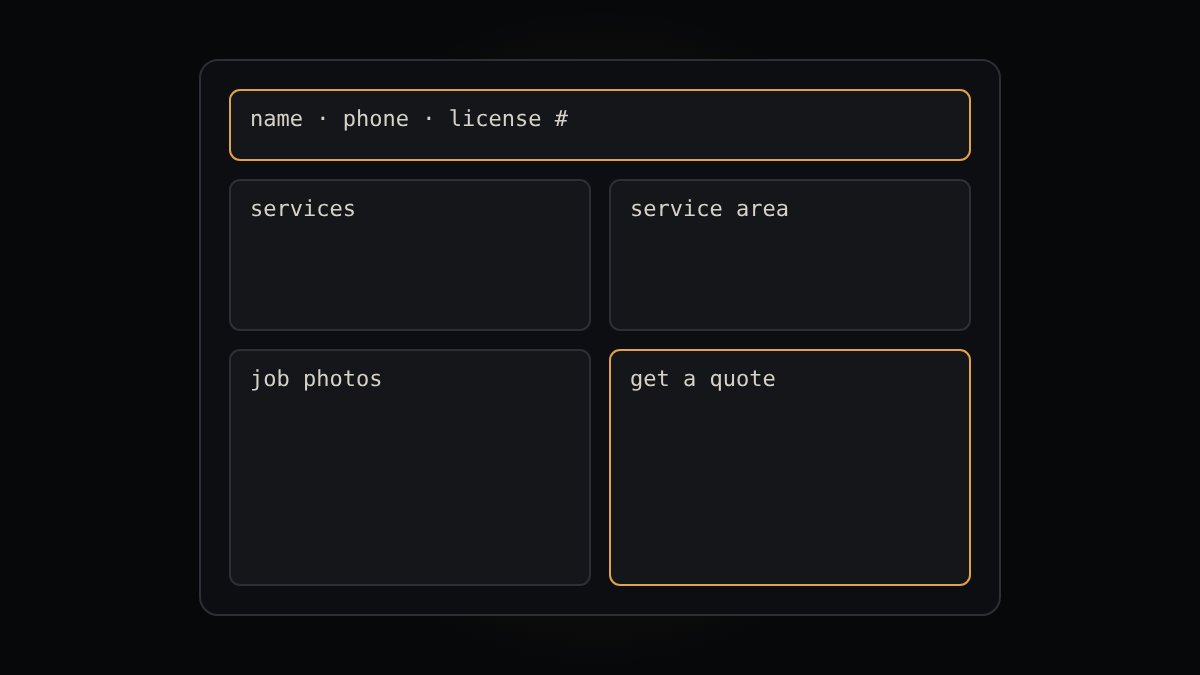
The layout that gets calls
- A header that works on a phone: business name, a tappable phone number, your license number and a "Get a quote" button.
- Services, each with a sentence on what's included. "Roof repair and replacement, asphalt and metal" beats "roofing solutions".
- Service area: the towns or counties you cover, by name.
- Recent work: photos of your own finished jobs, each with a line about the job and the town.
- Proof: license and insurance details, years in business, and real reviews or a link to them.
- The quote form (below), plus your hours and whether you take emergency calls.
Skip the stock photos of smiling workers. Homeowners can tell, and real job photos, even phone photos, do far more to show you're the real thing.
The quote form
Ask for just enough to call back with a useful answer:
- name, phone and email;
- the town or ZIP code, so you know it's in your area;
- what the job is, picked from your services, plus a sentence or two;
- how soon they need it.
Don't ask for a full street address on the first form; you can get it when you call. Send yourself a test, and reply to real requests the same day if you can. Speed wins more jobs than design.
A first reply that works, by text or email:
Hi Sam, thanks for your request about the leaking gutter in Riverside. I can come and look on Thursday between 8 and 10 am, or Friday after 2. The visit and estimate are free. Which suits you? (Lic. #000000)
It names the job and the town, so they know you read it; offers two concrete times; says what the visit costs; and carries your license number.
License number and advertising rules
Contractor licensing is set by each state, and several treat your website as advertising.
- California: the Contractors State License Board says your license number must appear in all advertising, including websites and online posts. You may not advertise that you're "bonded" when referring to the bond your license requires, and if you say you're insured, name the type of insurance.
- Florida: state law requires your registration or certification number in each offer of services, bid, contract or advertisement, regardless of medium.
- Elsewhere: rules vary, and some cities and counties add their own. Check your state licensing board's advertising rules before you publish.
Even where it isn't required, show the number and link to your state's license lookup. It costs nothing, reassures careful homeowners, and sets you apart from unlicensed competitors. This is general information, not legal advice.
Reviews and claims
Use only real reviews, with permission. The US Federal Trade Commission's rule on consumer reviews, in force since 2024, bans fake reviews and testimonials, including ones a business writes about itself. Linking to your Google reviews is simple and honest. The same goes for claims like "best in town" or "lowest prices": if you can't back it up, leave it out.
Get found locally
- Keep your name, phone and service area identical on your website and your Google Business Profile.
- Give each main service a short section or page that mentions the towns you work in, written for people, not keyword lists.
- Add a new job photo and a sentence every few weeks; it keeps the site current and shows you're busy.
Have an AI assistant draft it
An AI assistant can write and lay out the whole site from a description, and a publishing service that connects to the assistant can put it online. Give it your real details up front: services, service area, license number, insurance, hours and a few job photos. Ask it to put the license number in the header and footer and to keep the quote form to the fields above. Then check every claim before you publish; an assistant will happily write "fully bonded and insured" unless you tell it what's true. For the full walkthrough, with a live example and a comparison of services (one of them ModelBrain Live, our product), see how to build a website with Claude.
Before you publish
- Phone number and license number are on the first screen, and the phone is tappable.
- Services and towns are listed by name.
- Photos are of your own work.
- Bonding and insurance wording follows your state's rules.
- Reviews are real, with permission, or linked to the source.
- The quote form works: send yourself a test.
Common questions
Do I have to put my contractor license number on my website?
In some states, yes. California requires the license number in all advertising, and its licensing board counts websites and online posts as advertising. Florida requires the number in every advertisement regardless of medium. Even where it isn't required, showing it builds trust.
What should a contractor website include?
Your phone number and license number at the top, the services you offer, the towns you cover, photos of your own finished jobs, a quote request form, proof of insurance, and real reviews or a link to them.
Can I say I'm bonded and insured on my website?
Be careful with the wording. In California, contractors may not advertise that they are bonded when referring to the bond required for their license, and should name the type of insurance they carry rather than just saying insured. Check your state's rules.
How do I get more leads from my contractor website?
Make the phone number tappable and the quote form short, list the towns you serve by name, show recent jobs with a line about each, and reply quickly. Many people go with the first contractor who answers.
Can I post customer reviews on my website?
Yes, if they're real and you have permission to use them. Since 2024 the US Federal Trade Commission's rule bans fake reviews and testimonials, including ones written by the business. Linking to your Google reviews is a simple, honest option.
Can I build a contractor website with AI?
Yes. Give an AI assistant your services, service area, license and insurance details and real job photos, have it build the site, and check every claim before you publish.
Sources
- California Contractors State License Board, Advertising guidelines and license numbers in advertising.
- California Business and Professions Code, section 7027.4 (bonded and insured wording).
- The Florida Senate, Florida Statutes 489.119.
- US Federal Trade Commission, Rule on the use of consumer reviews and testimonials.
Last checked November 22, 2026. Written by Matthew Firth with help from an AI assistant; ModelBrain Live is our product.