Bakery Website Guide: Preorders, Allergens and Cottage Food Rules
 By Matthew Firth, founder of ModelBrain · Nov 22, 2026 · 8 min read
The short answer: a bakery website needs to answer four questions fast: what can I order, how far ahead, how do I get it, and is it safe for my allergies. That means a menu with prices and lead times, a preorder form, clear pickup details, and an allergen statement. If you bake at home, add the notice your state's cottage food law requires and keep your home address off the page. Below is what to include, the rules that catch home bakers out, and a working demo site built from one sentence.
What to put on it
| Section | Shop bakery | Home bakery |
|---|---|---|
| Main button | Preorder, or see today's menu | Order or request a custom cake |
| Menu | Today's case, with a note that items sell out | Everything you make, with prices and lead times |
| Ordering | Holiday and custom-cake preorders | Preorder form with a cut-off day |
| Location | Address, map and hours | A pickup area only; the address goes in the confirmation |
| Rules | Allergen statement | Allergen statement plus your state's cottage food notice |
| Extras | Wholesale inquiries, gift cards | FAQ on payment, cancellations and pickup |
Lead with the order button, not your story. Customers arrive with a date in mind ("I need a cake for Saturday"), so the first screen should tell them whether that's possible and how to ask. Your story, photos and reviews can sit further down.
Preorders and custom cakes
Most bakery orders are made ahead, so the order form is the most important part of the site. Ask for:
- name, email and phone;
- what they want, the size, flavor and colors;
- the pickup or delivery date;
- any message to pipe on top, and any allergies.
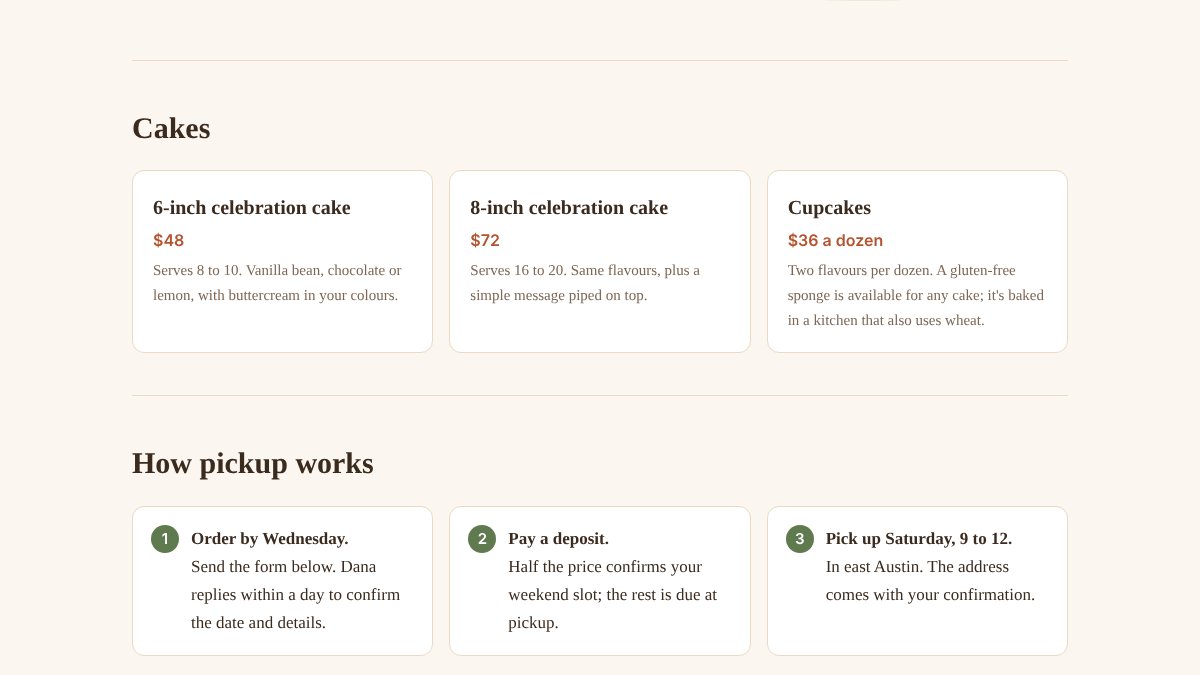
Then state your rules beside the form: the cut-off ("order by Wednesday for Saturday"), the lead time for custom cakes (many bakers ask for a week or more), the deposit and when the rest is due, and your cancellation policy. Confirm every order by reply before you bake. You don't need online payment on day one; a form that emails you and a deposit by your usual method works, and you can add a shop later when the volume justifies it.
Home bakers: cottage food rules
Every US state has a cottage food law that lets you sell certain homemade foods, usually baked goods that don't need refrigeration, but the details vary a lot and they affect your website directly. According to the Institute for Justice, which tracks these laws, 43 states plus Washington, D.C. allow cottage food businesses to sell online to buyers in the state, and 35 states plus D.C. allow mail delivery. The rest restrict one or both, and many also cap your yearly sales.
Texas, as an example. The Texas Department of State Health Services says that since September 1, 2025:
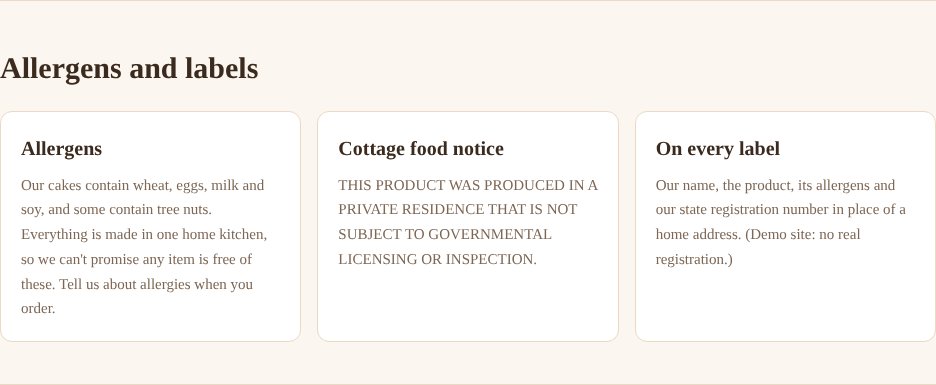
- labels must carry the statement "THIS PRODUCT WAS PRODUCED IN A PRIVATE RESIDENCE THAT IS NOT SUBJECT TO GOVERNMENTAL LICENSING OR INSPECTION.", plus your name, the product, and any major allergens;
- you can register with the state and print a registration number instead of your home address;
- you may sell online only if the food is then delivered in person by you, an employee or someone in your household, and before you take payment you must post the required label information on your website. In practice that means you or someone in your household hands the order over; a courier app or the post doesn't meet this rule;
- the yearly gross income limit is $150,000.
Your state will differ, so look up its health or agriculture department's cottage food page before you take online orders, and copy any required wording exactly. This is general information, not legal advice.
Allergens
Under US law the major food allergens are milk, eggs, fish, crustacean shellfish (such as shrimp, crab and lobster), tree nuts, peanuts, wheat, soybeans and sesame. Say which of these you use, and be honest about shared equipment: "made in a kitchen that also uses nuts" is more useful, and safer, than a promise you can't keep. Ask about allergies on the order form, and list allergens on each menu item if your range changes often.
Pickup without giving away your address
For a home bakery, don't publish your street address. Show a pickup area ("east Austin, near the park") and times, and send the exact address only in the order confirmation. If you'd rather not have customers at home at all, offer a regular public handover spot or your own delivery, within whatever your state allows.
Photos and copy
Use photos of your own bakes, in daylight, on a plain background. They don't need to be professional, but they do need to be yours. Write the way you'd talk to a customer at the counter, and keep your best sellers and prices visible without anyone having to open a PDF.
Build it by talking to an AI assistant
We built a demo for a fictional Texas home bakery, Juniper & Rye, by talking to Claude with ModelBrain Live, our product. It started from one sentence, "A home bakery in Austin that takes custom cake preorders for weekend pickup", and five answers about the menu, lead time, pickup and payment. It then got an allergen and cottage food section with the Texas notice. You can see it at demo-home-bakery.modelbrain.app; it's clearly labelled as a demo and hidden from search engines.
Our guide to building a website with Claude shows every step of that build, and compares the other ways to do it from an AI assistant, including Wix, Shopify and Zarla. Whatever you use, give the assistant your real prices, lead times and state, and check the result against this page before you publish.
Before you publish
- The order button is visible on the first screen, on a phone.
- Every item has a price and a lead time.
- The order form works: send yourself a test.
- Allergens are stated honestly, including shared equipment.
- Home bakers: your state's required notice is on the site, copied exactly, and your home address isn't.
- Photos are yours, and there are no made-up reviews.
Common questions
What should a bakery website include?
Your menu with prices and lead times, a way to preorder or request a custom cake, pickup or delivery details, opening hours if you have a shop, an allergen statement, photos of your own work, and contact details. Home bakers also need whatever disclosure their state's cottage food law requires.
Can I sell baked goods online from home?
In most states, yes. The Institute for Justice counts 43 states plus Washington, D.C. that let cottage food businesses sell online within the state, and 35 states plus D.C. that allow mail delivery. Check your state's agency before you take online orders.
How do I take cake orders on my website?
Use an order form that asks for the cake, size, flavor, date and any message, and say clearly how far ahead people must order. Reply to confirm each order and take a deposit before you bake. Many bakers start with a form that emails them and add online payment later.
Do I need to show my home address on a home bakery website?
No, and it's safer not to. Give a pickup area on the site and send the exact address with each confirmed order. Texas, for example, lets a registered home baker put a registration number on labels instead of a home address.
Do I need a website for my home bakery?
Not by law, but it saves you repeating your menu, prices and lead times in every message, and it gives customers somewhere to order that you control. A one-page site with a menu and an order form is enough to start.
How much does a bakery website cost?
A basic site can cost little or nothing to start on many builders; a custom domain is usually about $10 to $20 a year. Online payments add processing fees, typically a few percent per order.
Sources
- Texas Department of State Health Services, Texas Cottage Food Production, checked November 22, 2026.
- Institute for Justice, Homemade food and state cottage food reforms.
- US Food and Drug Administration, Food allergies (the nine major allergens).
Last checked November 22, 2026. Written by Matthew Firth with help from an AI assistant; ModelBrain Live is our product.